

What Is Baga? The Red Grape Behind Amalia Rosé and Blanc de Noirs
By Amalia Vineyard Alliance · Last updated October 2026
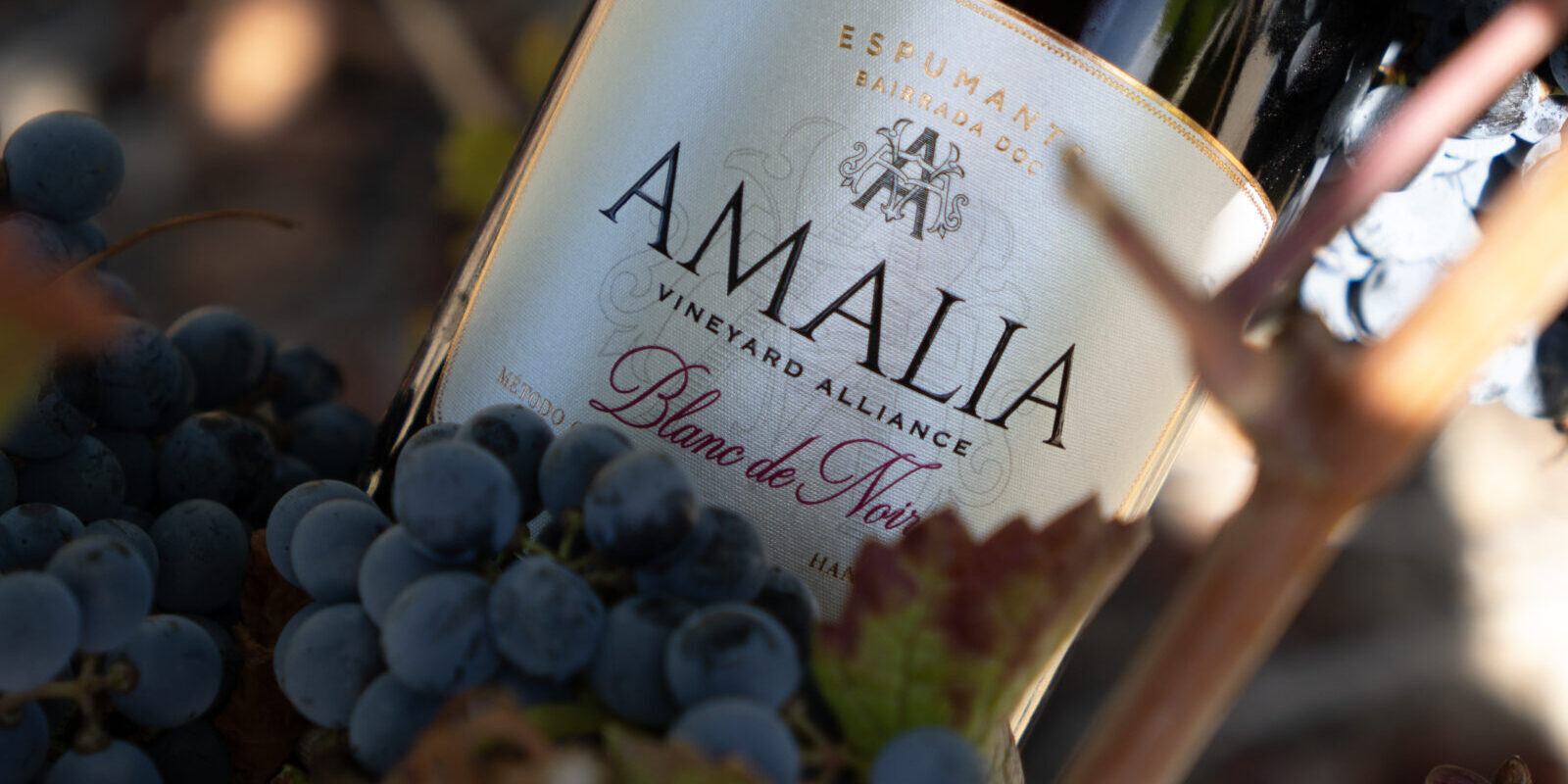
Baga is the native red grape of Bairrada, a coastal wine region in central Portugal. It is thin-skinned, late-ripening and high in both acidity and tannin, and it gives the region’s traditional-method sparkling wine its salty, mineral finish. Amalia Vineyard Alliance makes two of its three Espumantes from Baga: Amalia Rosé and Amalia Blanc de Noirs.
Both wines come from the same hand-picked grape. What separates them happens in the press, and the people who grow and make the wine explain it below in their own words. The third wine in the range, Amalia Blanc de Blancs, is made from the white grapes Bical and Arinto.
What is Baga?
Baga is Bairrada’s signature red grape. Its skins are thin, it ripens late, and it keeps high acidity and firm tannin, which makes it demanding in the vineyard and long-lived in the bottle. SevenFifty Daily describes it as a variety that “often draws comparisons to fellow finicky grapes like Pinot Noir and Nebbiolo,” which is where its nickname, the Pinot Noir of Portugal, comes from.
Left to ripen fully, Baga makes structured red wines that can age for decades. Albino, who walked us through the Alliance’s vineyards during the 2026 harvest, had recently opened a 1963 Baga at a lunch. “That is a luxury,” he told us, and in his view no other grape would have lasted that long in the bottle. Picked earlier, with its acidity intact, Baga becomes the base for método clássico sparkling wine.
The people who pour it for a living single out its finish. Eduardo Porto Carreiro, VP of Beverage at Rocket Farm Restaurants, told SevenFifty Daily: “It’s structured, it’s mouthwatering, it’s pure—and no matter the style, there’s always this salty, mineral finish.”
Why does Baga grow so well in Bairrada?
Bairrada lies between the city of Coimbra and the Atlantic, on clay-limestone soils with a cool, damp maritime climate. Albino’s explanation is short: “Baga likes this ground.” The ocean does the rest. The vineyards sit close enough to the sea to catch its breeze, and that gives the wines a freshness that, as he puts it, “you don’t find in many places.”
Wet weather is the risk. Baga has what Albino calls “a very sensitive skin,” and in rainy years it rots before the fruit is right. It needs warmth and dislikes morning fog on the leaves. The last few drier summers have suited it: “Baga is reaching levels it hadn’t reached in many years.”
How do you make sparkling wine from a red grape?
The juice of a red grape is almost colorless. The color, the tannin and most of the red-fruit aroma sit in the skins. To make a pale sparkling wine from Baga, the grapes go straight from the harvest to the press, and only the juice is fermented. How hard they are pressed decides the color of the wine.
Pedro, who makes the Amalia wines, describes the difference between the two. For the Rosé, the grapes are pressed up to a set pressure, enough for the juice to take on a reddish tint. For the Blanc de Noirs, the press never reaches that point. “The grapes are barely even crushed,” Pedro says, “so what comes out has no color at all.”
More pressure brings more than color. “It also brings tannins,” Pedro says, “and more red-fruit aromas.” That is why the Rosé shows cherry and red berry, with a little more grip on the palate, while the Blanc de Noirs is paler and leans toward quince and darker fruit.
From there, the two wines follow the same path as the whole range: a second fermentation in the bottle, at least nine months resting on the lees, and a finished pressure of 5.5 bar. The last step is the dosage, a small measure of wine added before the cork goes in. Pedro wants it to work as “an improver” of the wine, and for Amalia it was set together with founder António Coelho Lima. “He knows the market, we know the process,” Pedro says.
Amalia Rosé and Amalia Blanc de Noirs, side by side
Amalia Rosé | Amalia Blanc de Noirs | |
|---|---|---|
Grape | 100% Baga | 100% Baga |
Pressing | Pressed further, for color | Pressed very gently, grapes barely crushed |
Color | Salmon blush | Pale, with a coppery hue |
Nose | Tart wild raspberry, a little toastiness | Quince paste, red berry jelly, cassis, molasses |
Palate | Lively and crisp, with berry notes and a fine, persistent mousse | Elegant mousse, moderate freshness, long finish |
pH · total acidity | 3.25 · 6.8 g/L | 3.15 · 6.3 g/L |
Sugar | 7.0 g/L | 5.5 g/L |
Best with | On its own, red-fruit desserts, shellfish, delicate appetizers | Fish and white meats, through a whole meal |
Both are Brut, 12.5% alcohol, hand-harvested and fully destemmed. The Blanc de Noirs carries the Bairrada DOC.
Amalia Rosé
The Rosé is the more expressive of the two, and the one Pedro would pour on its own or alongside a dessert built on red fruit. He would also give it a wider glass than the others, filled a little more, because the color is the point. “It’s captivating in the glass,” he says. “The visual experience is the one that stays with us most.”
Amalia Blanc de Noirs
Pedro calls the Blanc de Noirs the most demanding wine he makes: you “take a red grape and remove almost everything,” and still have to make a sparkling wine of real quality. It never comes out entirely colorless, and he does not want it to. “It needs a few amber nuances, because that makes all the difference.” Those nuances are the coppery hue in the glass.
This is the wine of the range he would put on the table for a whole meal, from the first course to the last. It has the freshness for fish and enough intensity for meat.
Who grows the Baga in Amalia?
More than 500 farming families in Bairrada, each tending vineyards that average under two hectares. Every one of them harvests by hand, and their fruit goes into the same wines, so the care each family takes shows up in every bottle. You can read more about them on our farming and region page.
In the wine trade, sparkling wine made by the people who grow the grapes is called “farmer fizz,” a style best known through grower Champagne, where one family farms the land and makes the wine. AVA takes the same idea and spreads it across a whole community of growers, which is how a wine built on small family plots can reach restaurants and shops in the United States.
How should you serve Baga Espumante?
Cold, first of all. Pedro repeats it for every wine in the range: Espumante “has to be served and drunk well chilled,” or you lose the bubble, the aromas and the intensity on the palate. Around 6 to 8°C (43 to 46°F) is right.
On glassware he is relaxed. His own habit is a flute, which shows off the bead and holds the aromas in longer. A standard wine glass releases them faster, and he has no objection to it. “What matters is getting people to drink,” he says. The exception is the Rosé, which he prefers in a wider glass.
Frequently asked questions
What is Baga wine?
Baga is a native red grape from Portugal’s Bairrada region. It is thin-skinned, late-ripening and high in acidity and tannin. It makes structured, long-lived red wines and traditional-method sparkling wines, both Rosé and Blanc de Noirs, known for a salty, mineral finish.
Why is Baga called the Pinot Noir of Portugal?
Like Pinot Noir, Baga has thin skins, ripens late and is difficult to grow, and it shows clearly where it was grown. SevenFifty Daily notes that it often draws comparisons to Pinot Noir and Nebbiolo for those reasons.
What is a Blanc de Noirs?
A Blanc de Noirs is a white sparkling wine made from red grapes. The grapes are pressed so gently that the juice takes almost no color from the skins. Amalia Blanc de Noirs is made from 100% Baga and keeps a faint coppery hue.
How is a sparkling rosé made from Baga?
The Baga grapes are pressed harder than for a Blanc de Noirs, so the juice picks up some color, tannin and red-fruit aroma from the skins. It is then fermented and finished in the bottle by the traditional method. Amalia Rosé is 100% Baga, with a salmon blush.
What does “farmer fizz” mean?
Farmer fizz is sparkling wine made from grapes grown by the people behind the wine, prized for tasting of a specific place. AVA applies the idea across more than 500 Bairrada farming families who hand-harvest the grapes for its three wines.
Is Amalia available in the United States?
Yes. AVA is imported into the United States by Five Grapes, LLC, and the wines are carried by distributors in a number of states. Restaurants, retailers and other trade buyers are welcome to contact our commercial team directly. To hear from us as the range travels further, join our list.
New to the category? Start with our guide, What Is Portuguese Sparkling Wine? A Guide to Bairrada Espumante, or see all three wines.
Join our list for news from the harvest and the families who grow Amalia.